Timeless strategies. Tested, not guessed.

Theory of Edge takes the setups traders have relied on for decades, opening range breakouts, VWAP pullbacks, gaps, prior-day levels, and turns them into tested, ready-to-run NinjaTrader 8 strategies. No programming. Your own data, on your own machine.

1-minute dataexported from your own NinjaTrader
Out of sampleevery strategy is tested on data it never saw
Two NT8 algosone exports your data, one trades the result
01 How it works

Three steps, no code.

You do not need to know what a genetic algorithm is to use one. The Studio asks you for a data file and a few choices, then does the work. A step-by-step guide covers every screen.

STEP 1

Export your data

Open a 1-minute chart in NinjaTrader 8 for the market you want to trade, add the export algo we provide, and run it once. It writes a file with the history of that market.

Any futures market your NinjaTrader has 1-minute history for.

STEP 2

Run the engine

Pick the file, choose the trading session (US, European or Asian hours), tick the setups you want to combine, and start. The engine breeds thousands of strategy variations, keeps the ones that also work on data they never saw, and shows you each one with its full statistics.

STEP 3

Trade it in NinjaTrader

Each strategy is a short line of text. Copy it from the Studio, paste it into the trading algo we provide, and NinjaTrader runs it: first in the Strategy Analyzer to confirm the numbers, then on a simulation or live account.

02 The strategies

Built from real, timeless, tested setups.

Nothing exotic. The engine does not invent new indicators; it combines the setups professional desks have traded for decades, adds the right filters, stops and targets for your market, and keeps only what holds up out of sample.

The range built in the first 5 to 90 minutes of the session is the day's first consensus. A break above it is bought, a break below is sold, with a stop on the other side of the range. One of the oldest intraday setups, still traded on every index future.
What the engine tunesrange length, entry as market or stop order on the level, filters (relative volume, gap size, volatility regime), stop, target, time exit, and the clock offset after the open.
The first 15 to 120 minutes form the initial balance. The engine trades its breaks and its failures: when price extends beyond the balance, and when it is rejected back inside.
What the engine tunesbalance length, direction (long, short, both), filters, stop and target, maximum trades per day.
When the day trends, price keeps returning to the volume-weighted average and leaving again. The setup joins the trend on that return, with a moving average deciding which way the trend goes.
What the engine tunestrend average length, distance to VWAP, order type, stop and target, VWAP trailing stop.
The distance between today's open and yesterday's close. Small gaps tend to fill, large gaps tend to continue; the engine finds where the line is on your market and trades either side of it.
What the engine tunesgap threshold, continuation or fade, gap confirmation filters, time window, stop and target.
Yesterday's high and low are the reference points every trader watches. Breaks of them are traded as continuation; touches followed by rejection are traded as fades back toward the day's average.
What the engine tunesbreak or fade, distance beyond the level, order type, filters, stop and target.
The range built while the cash market was closed. Opening near its top or bottom carries information, and a sweep of its extremes followed by a reversal is a classic trap trade.
What the engine tunesposition in the range, sweep depth, reversal confirmation, stop and target.
After a stretch comes the pullback. Short-term RSI extremes and volatility squeezes (Bollinger inside Keltner, then release) catch the moment the stretch ends.
What the engine tunesindicator length and threshold, direction, filters, stop and target, exit on the opposite extreme.
The first minutes after the open and the second hour are not the same market. Each strategy can start its own clock up to two hours after the session open, in 15-minute steps, and the engine finds which offset suits each setup.
What the engine tunesopen offset (0 to 120 minutes), entry window, time exit, and the session itself: US, European or Asian hours.

Every strategy is a readable combination of one setup, up to two filters, a stop, a target and an exit time. You can read it, understand it, and paste it into NinjaTrader.

03 In NinjaTrader

What a result looks like, in your own platform.

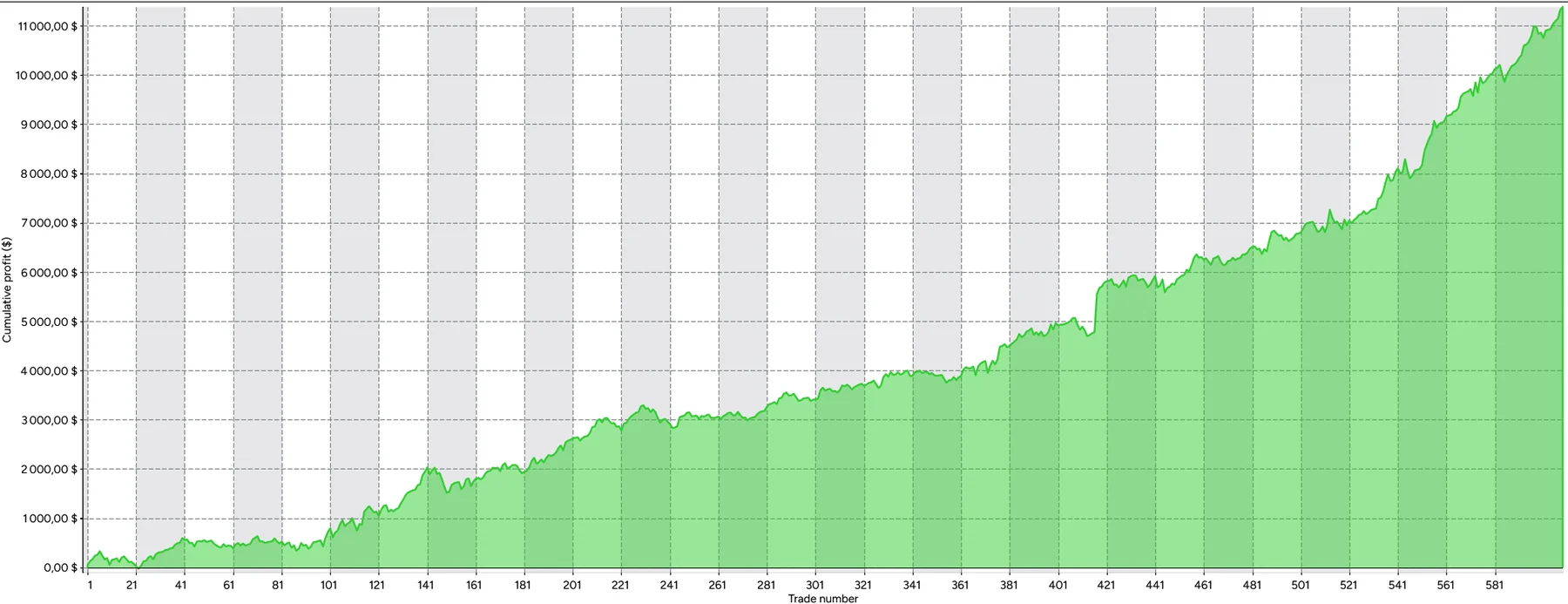
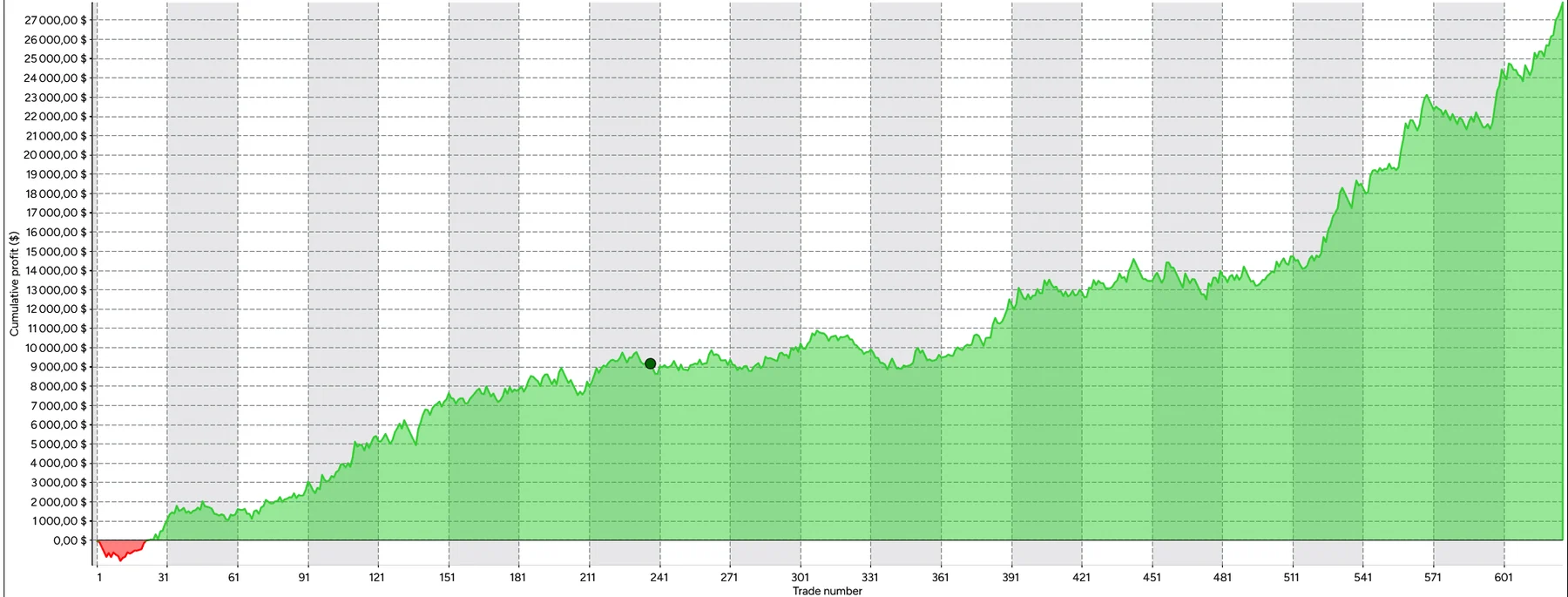
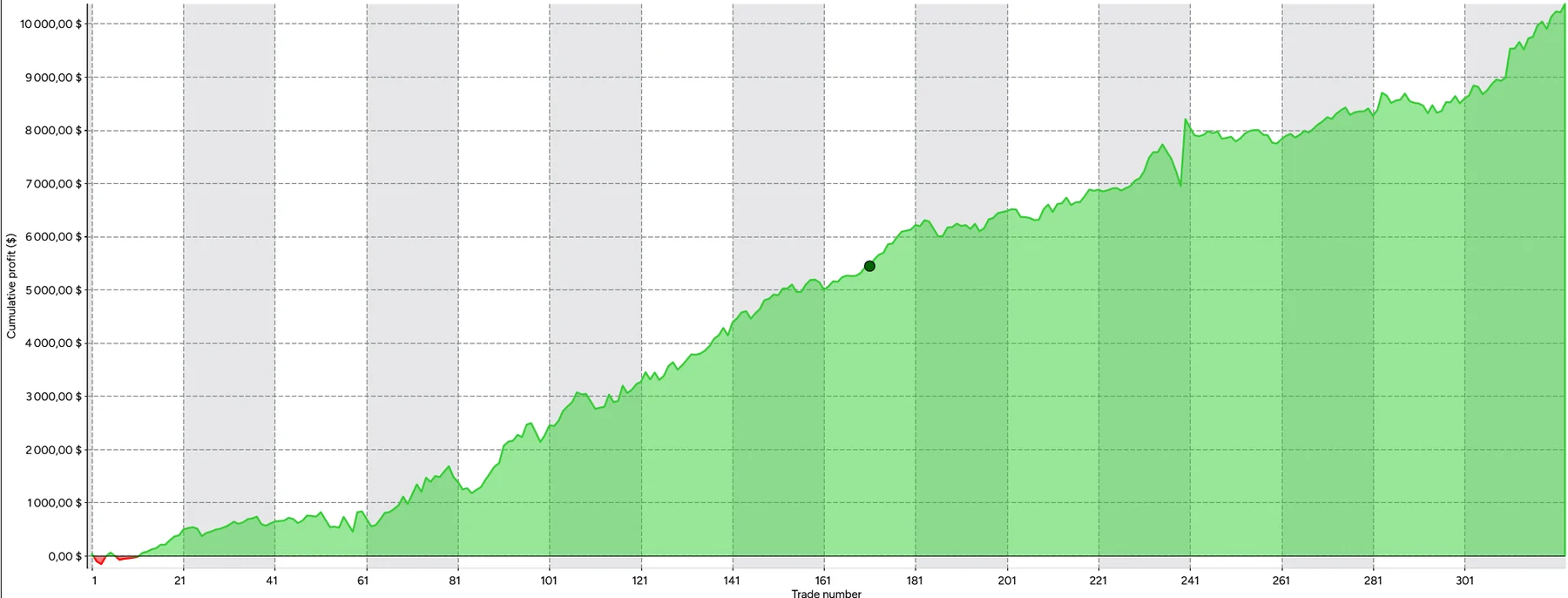
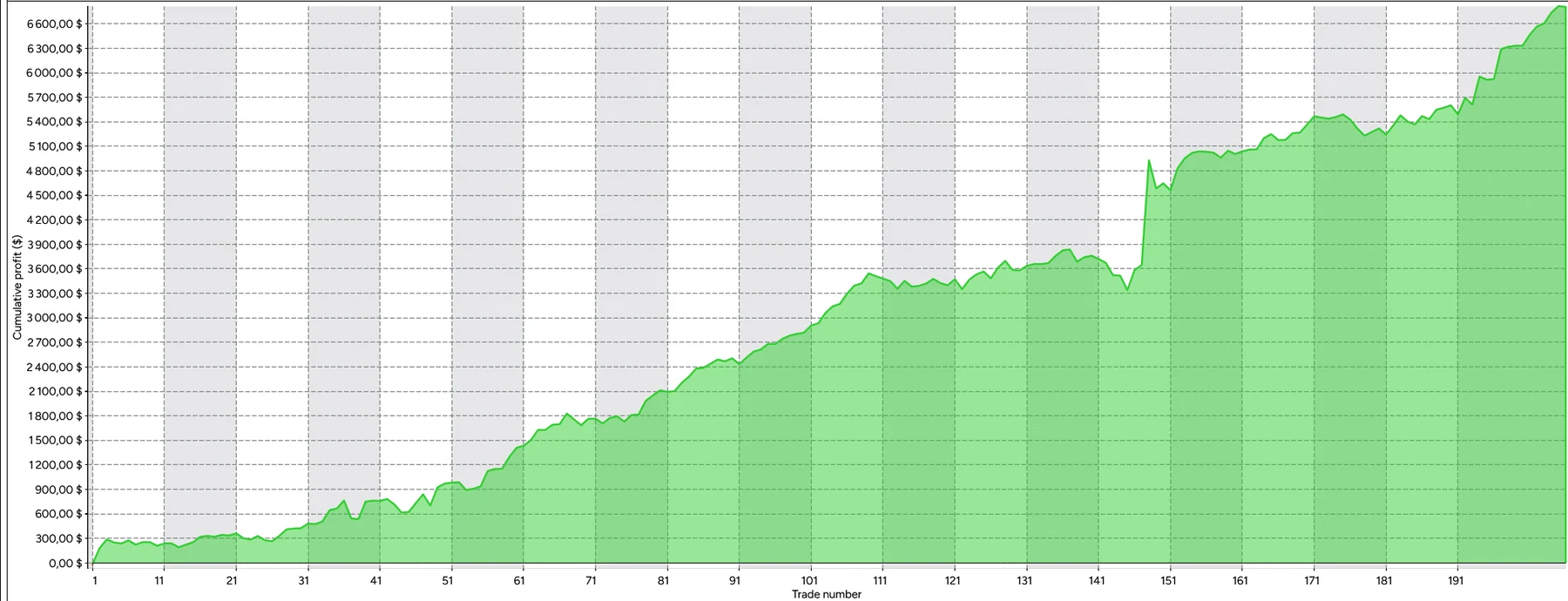
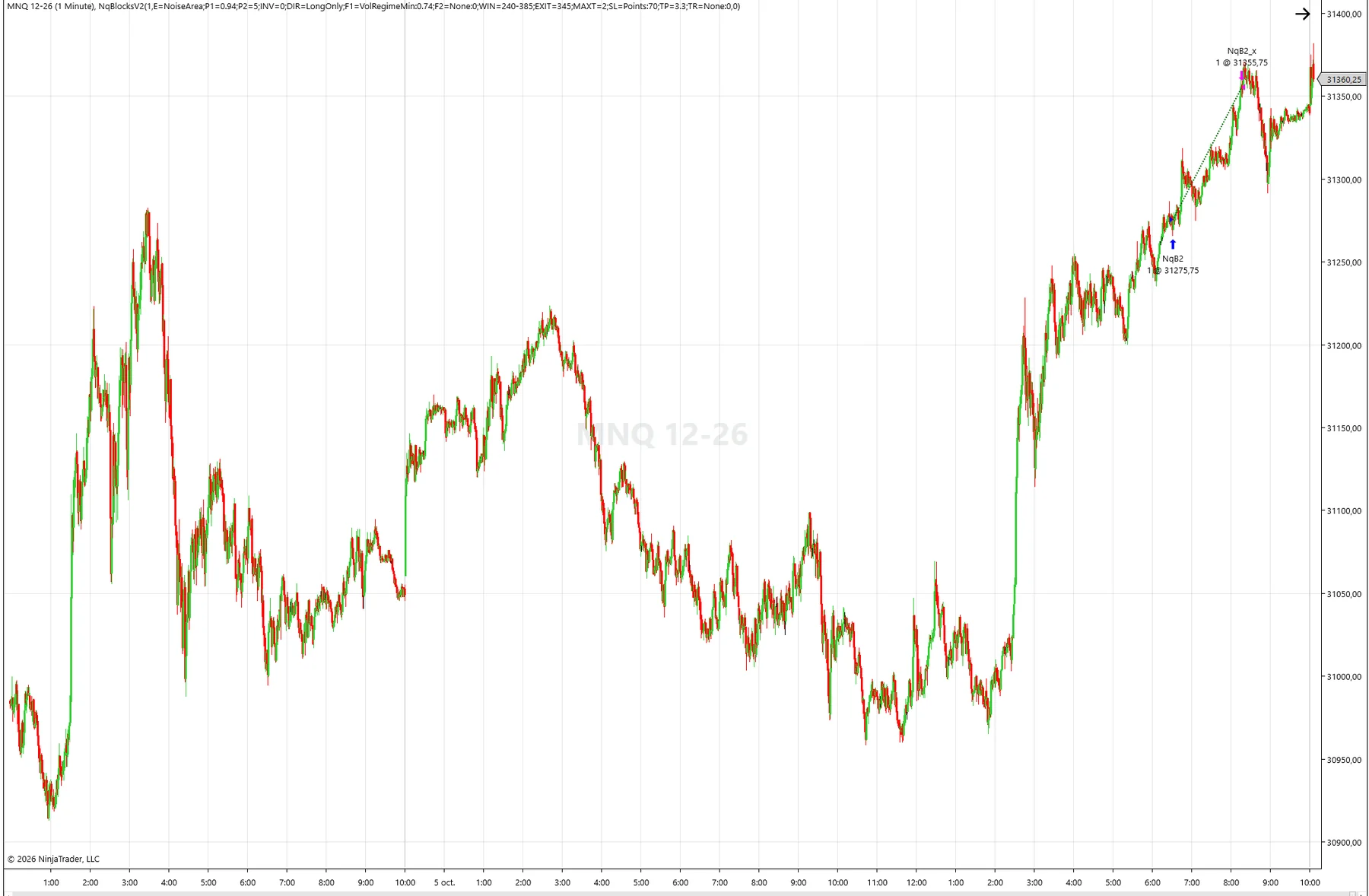
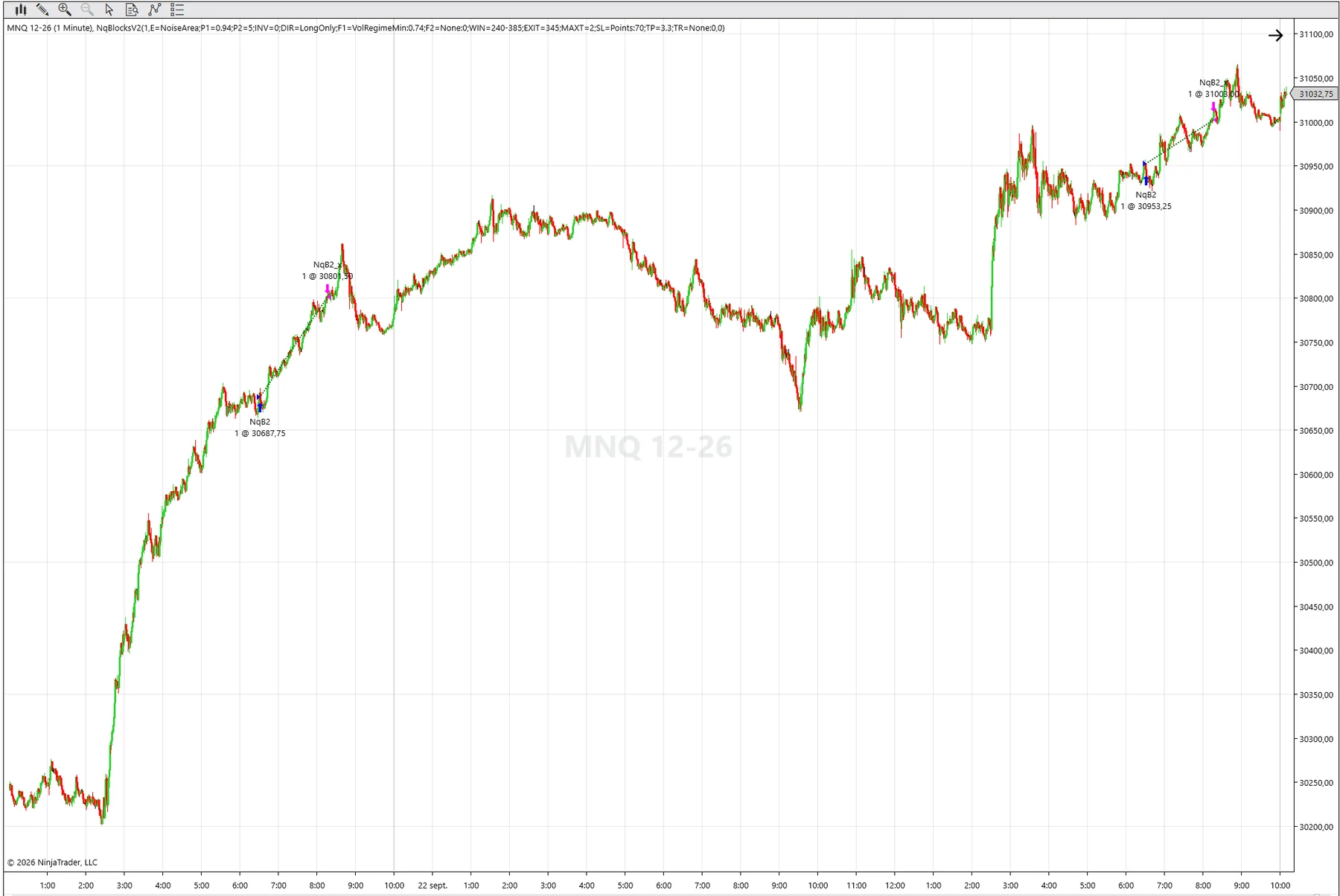
Strategies produced by the engine, replayed in the NinjaTrader 8 Strategy Analyzer on MNQ, one contract. The same core runs in the Studio and in NinjaTrader, bar by bar, so what you tested is what you see here.

NinjaTrader 8 Strategy Analyzer: cumulative net profit of a strategy on MNQ
NinjaTrader 8 Strategy Analyzer: cumulative net profit of a second strategy on MNQ
NinjaTrader 8 Strategy Analyzer: cumulative net profit of a third strategy on MNQ
NinjaTrader 8 Strategy Analyzer: cumulative net profit of a fourth strategy on MNQ
A strategy running on an MNQ 1-minute chart in NinjaTrader 8, entry and exit marked
The same strategy on another day, two trades marked

Backtests on historical data, hypothetical by nature. They include commission and one tick of slippage per side. They say what a strategy did, not what it will do.

04 The Studio

One window, from data to portfolio.

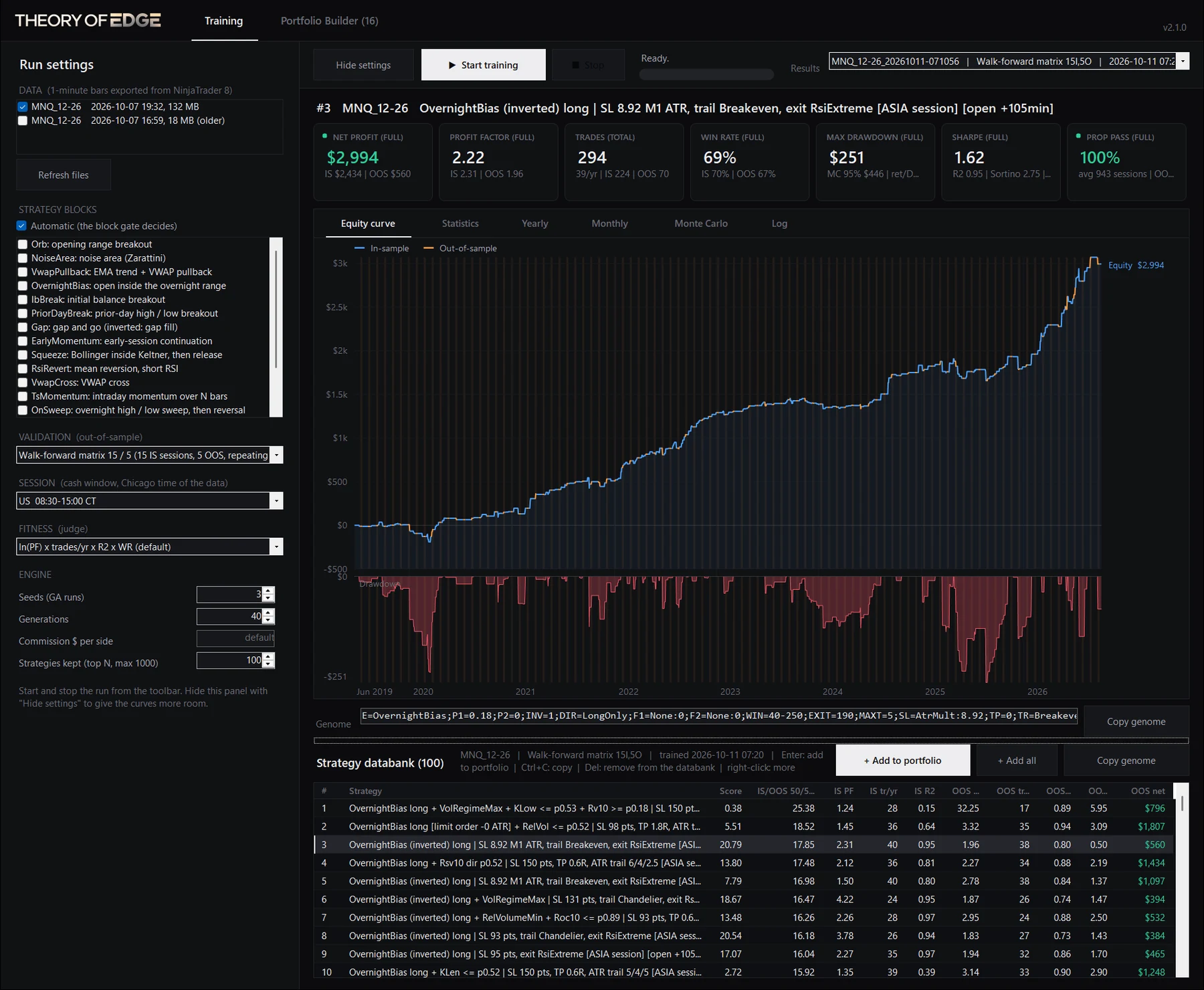
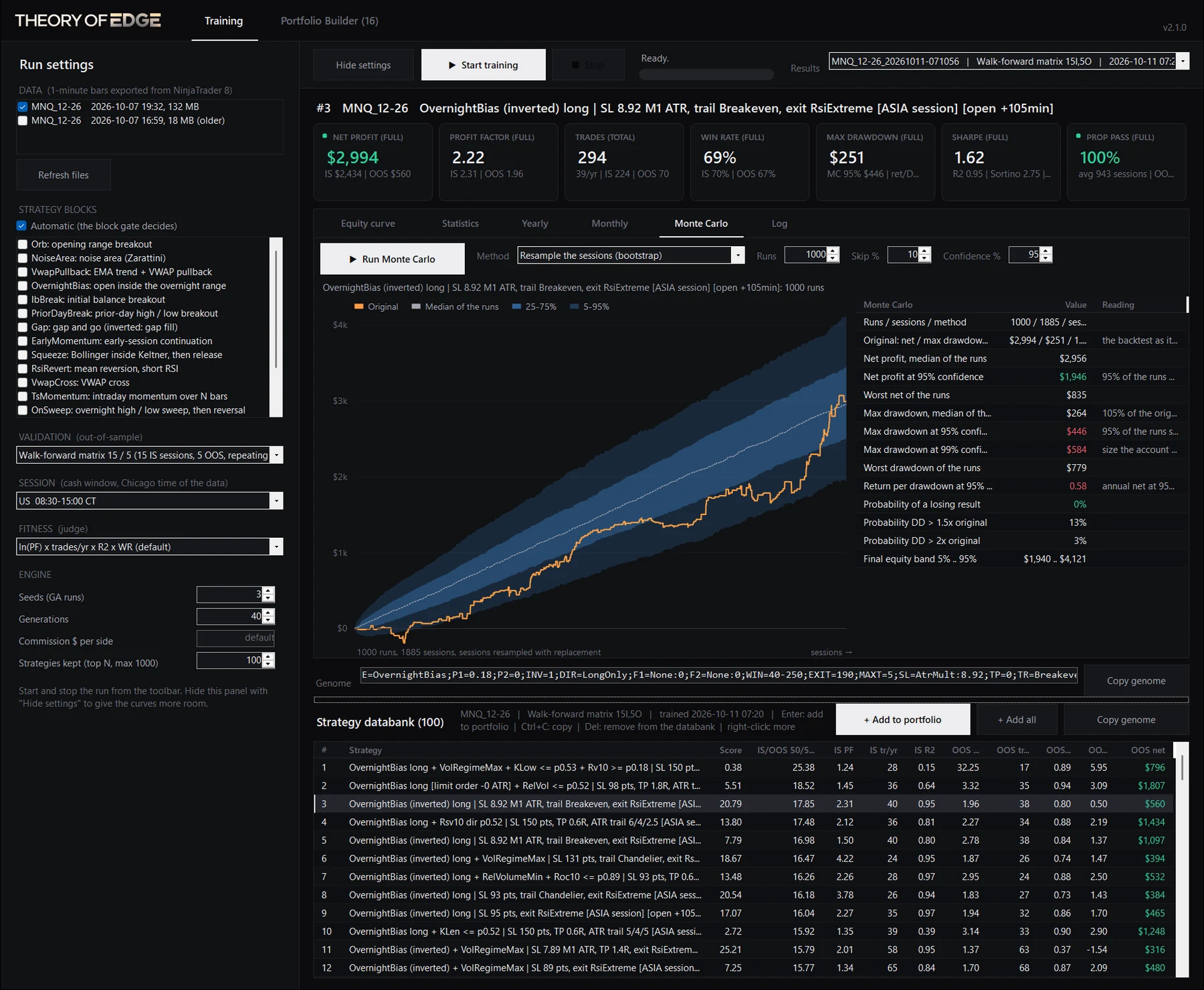
A Windows application. Everything below is a real capture of the current build.

Training: run settings, strategy setups, live leaderboard, equity curve and the strategy databank
Monte Carlo: the fan of 1,000 resampled equity paths around the original
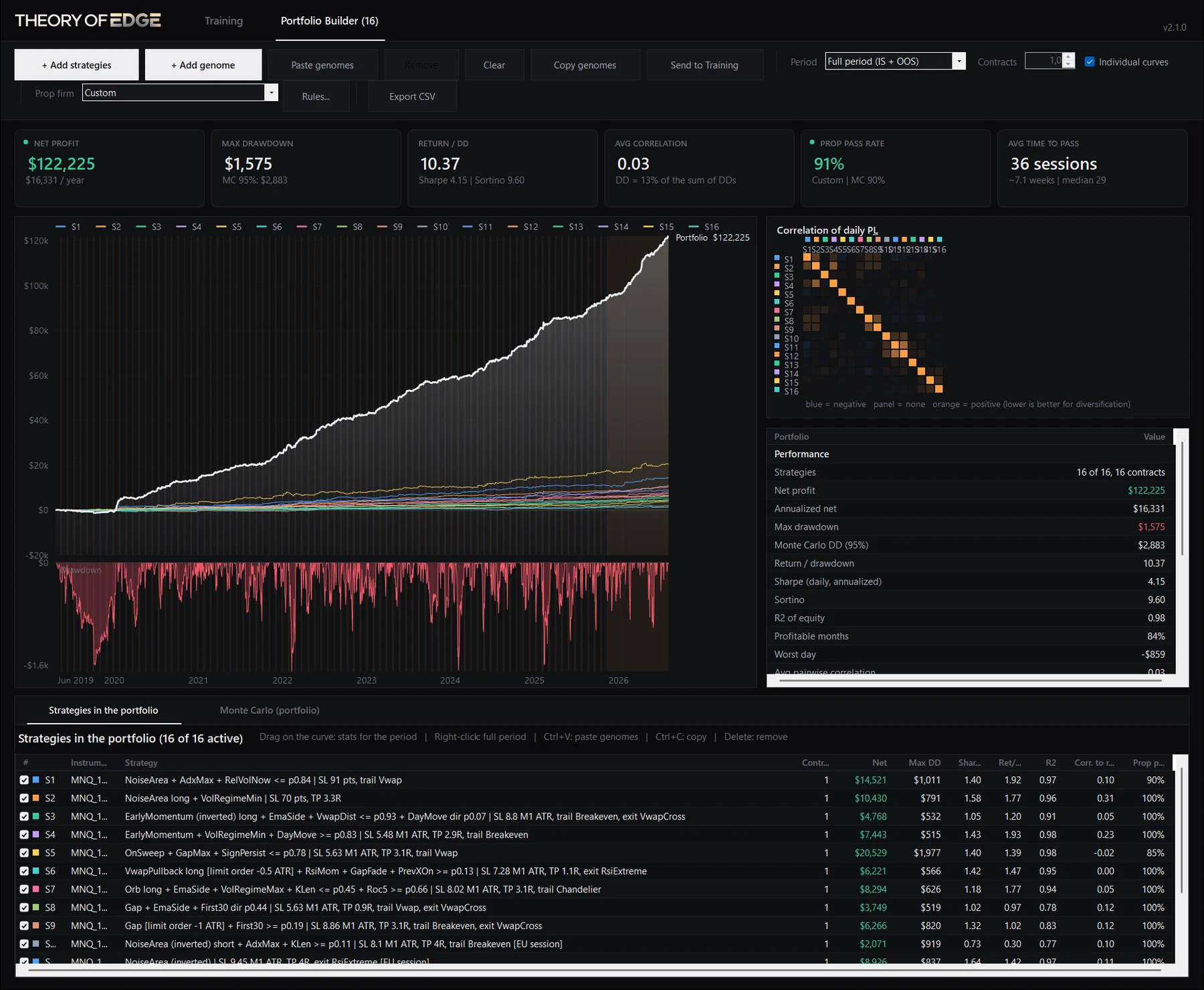
Portfolio Builder: strategies with contracts, combined equity, correlation, prop-firm simulation
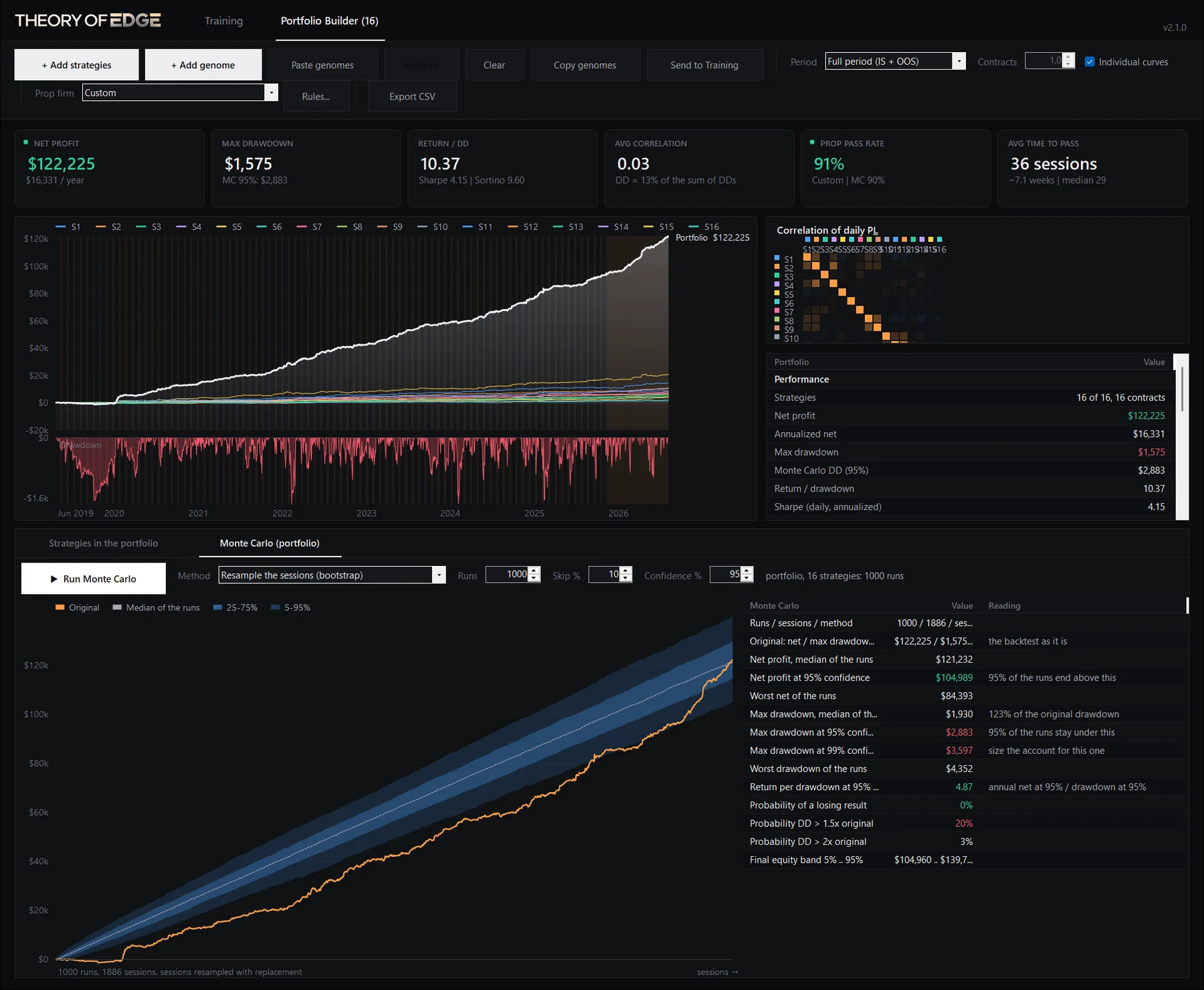
Monte Carlo of the whole portfolio
05 Access

One license. Everything included.

Limited number of licenses
$199per month, cancel anytime
  • The Studio for Windows: Training, Monte Carlo, Portfolio Builder
  • Two NinjaTrader 8 algos: one exports your 1-minute data, one trades any strategy, backtest and live
  • US, European and Asian sessions, on any futures market your NinjaTrader has data for
  • A step-by-step guide: export your data, run the engine, read the results, trade a strategy
  • Updates for as long as you subscribe
All sales are final, no refunds. Not available in Europe for now. Payment and licensing are not live yet on this page.

No. You export a file with one click, choose a few settings in the Studio, and paste a line of text into NinjaTrader. The guide shows every step with screenshots.

It is built for advanced traders: people who already know what a drawdown, a profit factor and an out-of-sample test are, and who have traded futures before. That said, if you have the desire to learn and you know how to manage your emotions when a strategy goes through a losing streak, we think it can suit you. The software does the heavy work; the discipline stays yours.

Three things: the Studio (a Windows application), a NinjaTrader 8 export algo that writes your 1-minute data into the file the Studio reads, and a NinjaTrader 8 trading algo that runs any strategy the Studio produced. Plus a step-by-step guide.

Any futures market your NinjaTrader 8 has 1-minute history for. You choose the session the engine works on: US hours, European hours or Asian hours, all in the time of your data. Each strategy can also start its clock up to two hours after the open.

Windows 10 or 11, NinjaTrader 8 with historical 1-minute data (a free NinjaTrader license is enough to backtest), and the .NET 8 runtime. No GPU, no external data feed. There is no Mac version: NinjaTrader 8 itself runs on Windows.

All countries that are not under United States sanctions, with one exception: we do not sell in Europe for the moment, and we do not know yet whether the product will become available to European residents. If that changes, it will be announced on this page.

No. The captures on this page, in the Studio and in NinjaTrader, show exactly what you get.

There are no refunds whatsoever. All sales are final. You can cancel at any time, which stops the next monthly charge; the current month stays active until its end.

We cap the number of active licenses. Strategies on liquid futures do not suffer from a few hundred users, but they would from tens of thousands running the same setups at the same minute, and we would rather keep support personal. When the cap is reached, new sign-ups go on a waiting list.

Yes, by invitation. Contact us with who you are and where you would present the product. We review every application, because we want to keep the wrong kind of promotion away from it.

The trading algo runs inside your own NinjaTrader, on whatever account you connect. Whether automated strategies are allowed on a given account is between you and your broker or prop firm: read their rules first. The Portfolio Builder can simulate a challenge with the rules you enter, so you see the pass rate before you pay a fee.

Everything stays on your machine: your market data, your runs, your strategies, your portfolios. The Studio only contacts our server to check that your license is valid. See the privacy policy.

You can never be certain, and anyone who says otherwise is selling something. What the Studio does: every strategy must be profitable on data it never saw during the search; near-duplicates are dropped; the Monte Carlo shows you the range of outcomes; the portfolio shows how strategies behave together. The decision stays yours, with the numbers in front of you.

$199 per month, billed monthly, cancel whenever you want; access runs to the end of the paid month. The license covers the Studio, both NinjaTrader 8 algos, the guide and every update released while you subscribe. One license, one trader, your own machines.

06 Who we are

Two quant traders who got tired of the race.

For years we designed and ran market-making and statistical-arbitrage strategies. If you know the models, Avellaneda-Stoikov, Cartea-Jaimungal, pairs and basket arbitrage, you know what that life is: a very small edge that does not last, a model to re-estimate every few days, a new asset to calibrate every week, and a latency budget where one millisecond separates a strategy that earns from one that bleeds. The research never stops, and neither does the adaptation.

THE TURN

Simpler, slower, reproducible

We wanted the opposite: something we could sit down with once every few weeks, not every night. Strategies with a logic a human can read, built from setups that have been traded for decades and still work because they rest on how sessions open, how ranges break and how prices return to value, not on a speed advantage someone will take from us next quarter.

So we built, for ourselves, a strategy builder: it breeds thousands of readable strategies from those setups, keeps only the ones that hold up on data they never saw, and lets us assemble them into portfolios. That tool is what you are looking at.

WHY PROP FIRMS

Where cash flow starts without a large balance

We talked to many traders before opening it up. Most of them wanted the same thing: to pass a prop-firm evaluation. They are right to. For a trader without a large balance, a funded account is the fastest path to real cash flow, and an evaluation is a well-defined problem: a profit target, a loss limit, a number of days. A problem with limits is a problem you can simulate.

That is why the Portfolio Builder has a challenge simulator: you enter the rules of the firm you are looking at, and the Studio tells you how often a portfolio started on a past date would have passed, and in how many sessions.

THE BET

Focus where things are simple and repeatable

The whole project rests on one belief: it is better to be very good at something simple, repeatable and relatively easy than average at something brilliant and fragile. An ultra-refined model can be beautiful and still collapse on a data-feed hiccup. A portfolio of plain intraday setups, tested out of sample, sized on its bad days, is boring. Boring is what we were after.

We use it ourselves. We do not sell signals, we do not manage money, and we do not promise results: we give you the tool and the numbers, and we tell you where they come from.

07 From strategies to a portfolio

One strategy is a bet. Ten uncorrelated ones are a business.

A single strategy, however good its backtest, has months where it loses. That is not a flaw, it is what a strategy is. The way out is not a better strategy; it is several strategies that do not lose at the same time. The Studio is built around that idea from the first screen to the last.

BUILD

Collect strategies that differ

Run the engine on the setups and sessions you choose. Every run leaves a databank of strategies, each one profitable in sample and out of sample, each one a readable line. Different setups react to different days: a breakout strategy earns on trend days, a mean-reversion one on range days, a gap strategy only when there is a gap.

ASSEMBLE

Combine, and watch the drawdown shrink

In the Portfolio Builder you add strategies from any run, set contracts per strategy, and read two things side by side: the combined equity curve, and its drawdown against the sum of each strategy's drawdown. The correlation between strategies tells you whether you are diversifying or just doubling the same bet. Low correlation is the whole point.

VALIDATE

Stress it, then simulate the challenge

Run the Monte Carlo on the whole portfolio to see the drawdown to expect at 95% confidence, not the one that happened to show up in the backtest. Then enter the rules of your evaluation: target, loss limit, time. The simulator starts the portfolio on hundreds of past dates and gives you the pass rate and the average number of sessions to pass. You decide with those numbers, not with a feeling.

The Studio validates your own portfolios, on your own data, with your own rules. It does not hand you a portfolio and it does not tell you what to trade: it tells you what the one you assembled would have done, and how robust that is.